


Tracking Catfish & Following the Fish Over Time
Tagging Individual Catfish
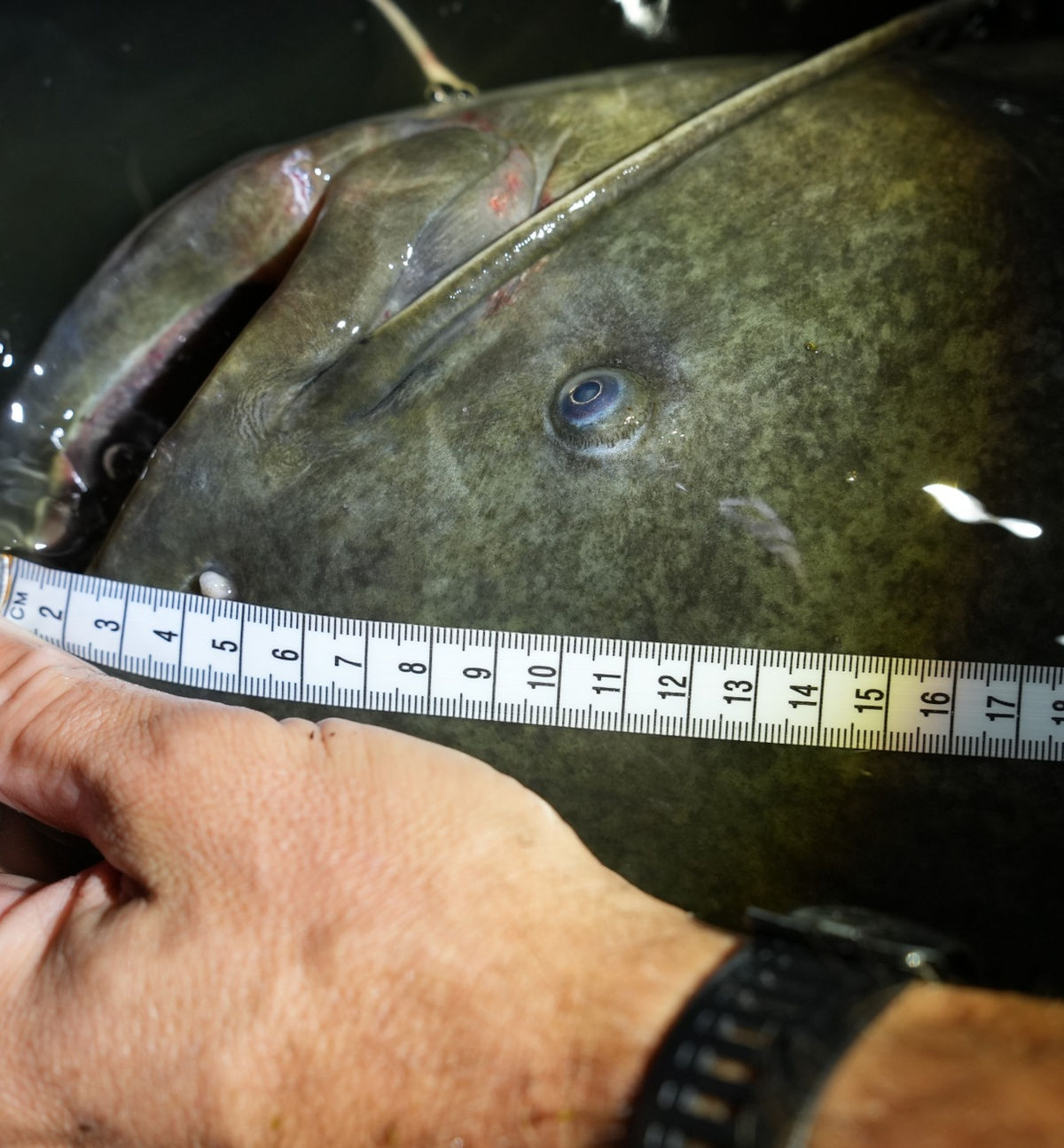
Catfish that have not previously been tagged are fitted with a PIT tag (Passive Integrated Transponder). This is a small electronic tag that is inserted into the fish's abdominal cavity. Each PIT tag has a unique identification number that can be read using a scanner.
This unique ID allows researchers to recognise the same fish if it is caught again in the future. By following individual fish over time, researchers can study their growth and movements.
When enough fish have been tagged, information from capture and recapture can also be used to estimate the size of the catfish population in Lake Båven. A PIT tag contains a unique identification number that can be read with a scanner.
Tracking Catfish with Acoustic Tags
To study the movements of catfish in greater detail, some adult fish are fitted with acoustic transmitters. The transmitter is placed inside the fish's abdominal cavity during a minor surgical procedure.
Before the procedure, the fish is anaesthetised and placed in a specially designed tagging cradle. A small incision is made with a scalpel, and the acoustic transmitter is carefully inserted into the abdominal cavity. The incision is then closed with stitches.
Throughout the procedure, water is continuously passed over the fish's gills to maintain proper ventilation. An acoustic transmitter is placed inside the abdominal cavity of an adult catfish during a minor surgical procedure. The fish is continuously ventilated with water throughout the procedure. Photo: Henrik Jeuthe.
Following the Fish Over Time
Unlike PIT tags, acoustic transmitters actively send out individual ID signals. These signals can be detected by receivers placed at different locations throughout the lake system.
This technology allows researchers to follow tagged fish continuously and see where they move over time without having to locate each fish manually. It provides detailed information about when and where individual catfish move within Lake Båven.
Depending on the type of transmitter used, acoustic telemetry can also collect information beyond location, including the fish's body temperature and swimming depth. By combining genetic sampling, PIT tagging, and acoustic tracking, researchers can build a more complete picture of the catfish population in Lake Båven. Together, these methods provide valuable information about population size, genetics, growth, and movement patterns, knowledge that can support the long-term monitoring and management of the species.
By Rickard Gustafsson , Fisheries Biologist at Sportfiskarna.
About the author: Rickard Gustafsson is a fisheries biologist at Sportfiskarna. His work focuses on fish migration, tagging studies, habitat restoration, and the conservation of freshwater fish populations.
Read more

How do pike move through the wetland, and do the same fish return to spawn year after year? At Hemmesta Sjöäng, a monitoring project will combine PIT tagging, a fish camera, and biological sampling...
Catfish in Lake Båven are tagged with PIT tags and acoustic transmitters to help researchers study individual fish and the wider population. PIT tags allow fish to be identified when recap...
What can a tagged fish tell us? Fish tagging reveals where fish travel, how they grow, and how they respond to changing environments. From advanced acoustic transmitters to tiny PIT tags, these too...